Specialist Features
Request a quote
Click here to request a quote.
Would you like someone to contact you?
Click here to arrange a call or visit
FAQs
What does each colour represent?
Sharpsafe® sharps container lids are available in four colours:
Orange – Sharps for incineration or alternative treatment. Marked “Fully Discharged Sharps” for use with fully discharged sharps not contaminated with prescription only medicines (POMs).
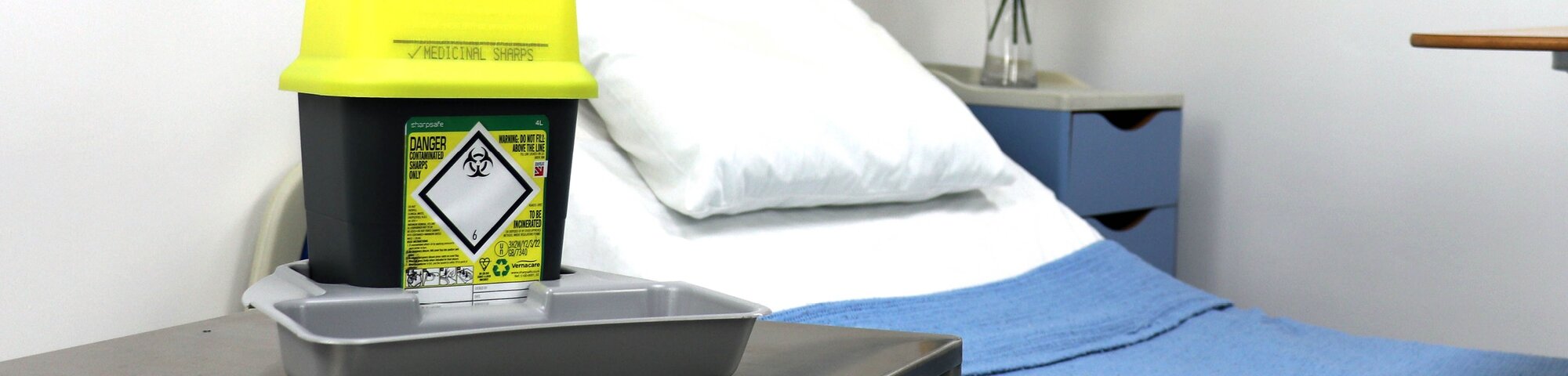
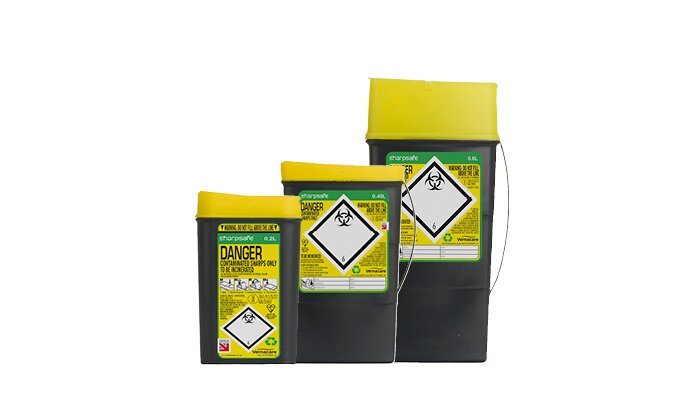
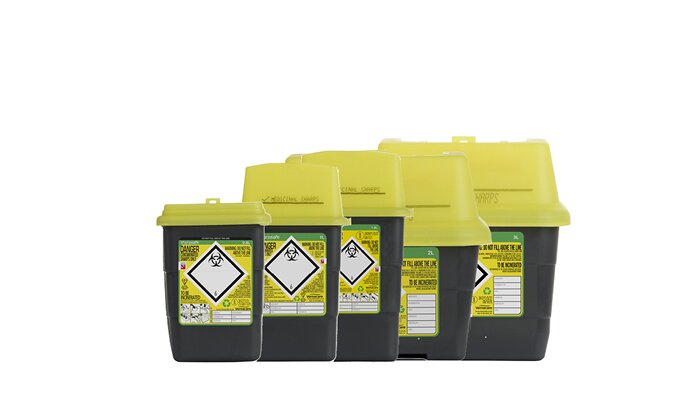
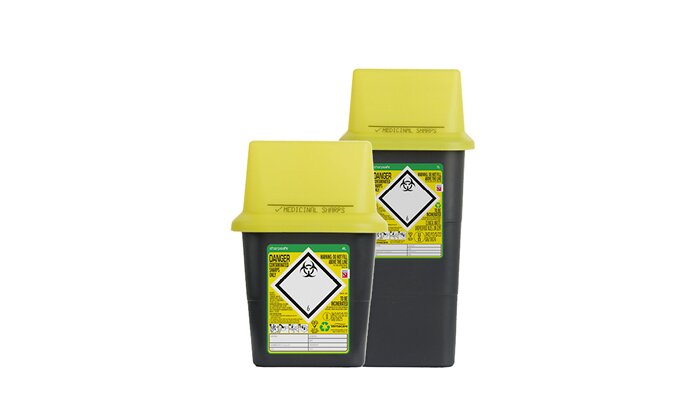
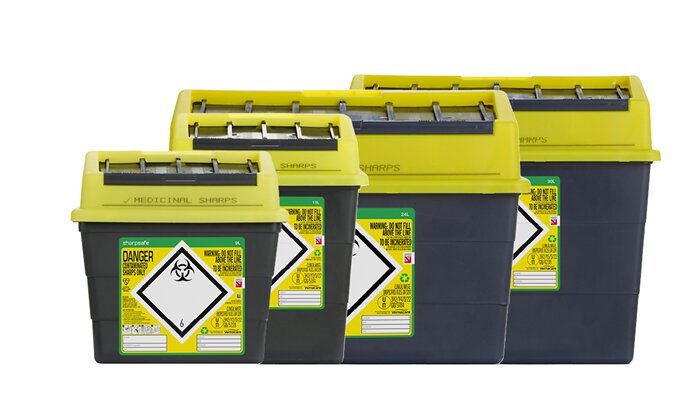
Yellow – Sharps including infectious sharps for incineration only. Marked with “Medicinal Sharps” For use with sharps waste including those contaminated with medicines other than those which are cytotoxic/cytostatic.
Purple – sharps which are contaminated with cytotoxic and cytostatic medicines. Marked “Cyto sharps”.
Blue Lid - Sharpsafe® Pharma waste containers are available with labels designating “Solid Pharmaceutical Waste”. These containers comply with UN 3249 and the in-mould labels reflect this fact.
Are these colours going to be the same for England/Wales/Scotland/Northern Ireland?
The Safe Management of Healthcare Waste (HTM-07-01) document has been adopted by the health services of England, Scotland and Wales. However, it is likely that further guidance may be issued relating to Scotland. This guidance has not been adopted by Northern Ireland.
Which size containers will this affect?
This guidance covers all clinical waste containers, including all sizes of sharps containers.
Will these containers comply with the new waste regulation?
Yes – the Sharpsafe® colour-coded range will continue to comply with all relevant regulations
Can I order through NHS Logistics?
NHS Logistics is now known as NHS Supply Chain since the organisation was outsourced to DHL. A full range of Sharpsafe® containers in each of the three colours is stocked by NHS Supply Chain.
Will the containers still comply with BS?
Yes BS7320:1990 is still the applicable standard for sharps containers and, whilst Safe Management of Healthcare Waste does not make reference to the standard, Frontier will ensure that all Sharpsafe® products continue to comply.
Why do we need a message printed on the lid?
Frontier has decided to keep a standard, generic label on the base of the container and to print a message on the lid for two reasons:
- Whilst lids and bases are packed in the same carton they occasionally get mixed up before they are assembled at point of use. Consequently, if both the labels on the bases and the lid are specific, there is a significant danger that they may be mismatched – e.g., the label says one thing about the contents and the colour of the lid implies another;
- The message on the lid is designed to give users of the container a clearly visible indication of what should be placed in it – whilst labels are useful for reference, they are less immediately obvious for users in a busy healthcare environment.
- The tick denotes it is acceptable to place specific waste into that colour container e.g. “Cyto Sharps” indicates it is ok to place cytotoxic or cytostatic contaminated sharps into this container.
In addition, the retention of the generic label allows customers an easy “migration path” in that the “standard” yellow-lidded products may continue to be used for all sharps until the organisation is ready to adopt the new guidance.
In short, Frontier has tried to keep the colour-coding system as simple and failsafe as possible, given its unavoidable complexities.
Which colour should I use?
The guidance offers organisations a degree of flexibility and the colour or combination of colours adopted is likely to vary due to differing circumstances including capability to segregate at point of use, type of healthcare facility and waste disposal arrangements. Separate guidance has been produced to advise Sharpsafe® users as to the most appropriate colour combinations for their particular circumstances.
Do I need super-absorbent sachets in the container?
Not in the normal circumstances. So long as there are not significant quantities of free liquid in the container and the container is correctly assembled and closed, no leakage should occur. Sharpsafe® containers are specifically designed to retain liquids in normal use as a sharps container and whilst not being “leakproof” in the technical sense, they do offer greater levels of fluid retention than other products available in the UK.
How much liquid can I dispose of in these containers?
Sharpsafe® containers comply with BS7320:1990 which require them to retain liquids up to 5% of their nominal capacity. In practice, it is considered that residual contents of syringes can continue to be disposed of in Sharpsafe® sharps containers.
Can I still order super-absorbent sachets?
These sachets can still be ordered directly from Frontier should they be required for particular circumstances.
Are they more expensive?
As would be expected, the colour-coded products are more expensive to manufacture. However, Frontier have chosen to absorb this additional cost and to sell the new colour-coded products at the same price as the old range.
Can I still order black containers?
Black-lidded containers were previously used by many customers to designate the presence of cytotoxic contaminated sharps. These containers have been superseded by the purple-lidded containers within the new colour-coded range. However, black-lidded containers will continue to be available by special arrangement direct from the factory.
Do you manufacture a leakproof container?
“Leakproof” is both a common-usage adjective (“so constructed or contrived as to prevent leaks or leakage”; “designed to prevent leaking”; “not subject to leaks”, according to various dictionaries) and a technical term.
Standard Sharpsafe® products are designed primarily as sharps containers and performance tested in accordance with:
- BS7320:1990 – which, in this context, requires the container to retain liquids of 5% of nominal volume; and
- UN3291 – for solids, which has no specific requirement relating to fluid retention as it is not anticipated that large quantities of liquids will be present. Consequently, so long as substantial quantities of free liquid are not present, it may be considered that Sharpsafe® containers are functionally “leakproof”.
However, where substantial quantities of free liquids need to be contained, it is appropriate for a product designed for this specific purpose to be used. In this context, it would be appropriate for the container to comply with UN specifications for liquid containers which require pressure testing, implying a far greater level of fluid retention.
Frontier aim to add such containers to the Sharpsafe® range to enable large quantities of liquids to be appropriately contained during the route to disposal.
Are these stock items?
Yes, these products are stocked by NHS Supply Chain, Welsh Health Supplies and National Procurement NHS Scotland. The products will also be available as stock items through independent distributors. A factory stock is maintained, available for immediate dispatch.
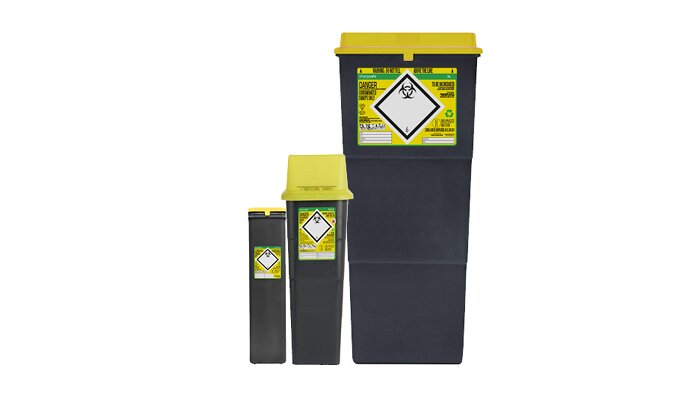
Will these colour changes apply to the 30 & 60 Litre clinical waste containers?
Yes, the guidance covers all clinical waste containers. However, in practice, it is likely that the majority of these containers will continue to have yellow lids.
Will the in-mould label change?
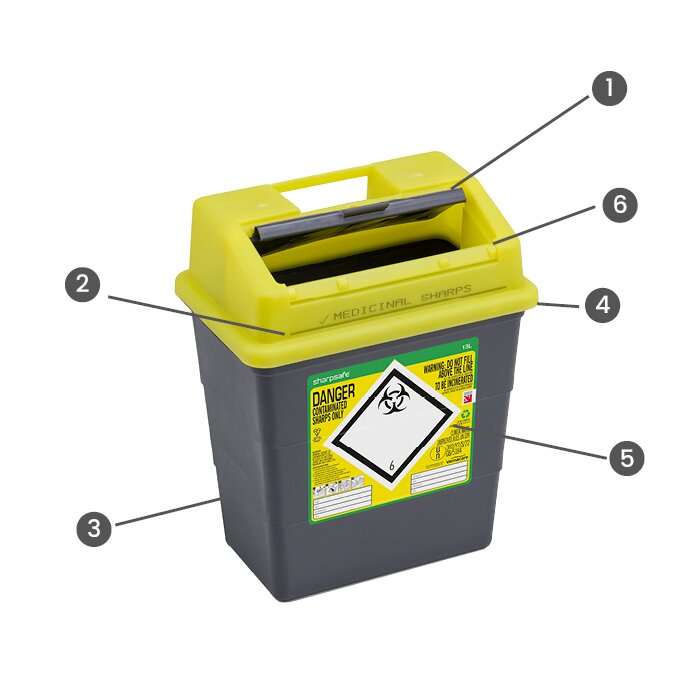
The in-mould labels on the Sharpsafe® range of sharps containers are unchanged and include:
Clear written and pictorial instructions on the use of the products
All necessary regulatory information
- British Standard information and kitemark
- UN classification (UN 3291) and code
- Disposal instructions
This main benefit of one standard label is its simplicity and lack of opportunity for mismatch with different coloured lids.
Why do Sharpsafe® labels not include EWC codes?
European Waste Catalogue (EWC) codes are mandatory for all waste documentation – i.e., it is necessary for the documentation which accompanies the consignment of waste containers to state what the waste is, including its classification per the EWC. Contaminated sharps could fit into any one of approximately 10 EWC codes dependent on particular circumstances. If the container label includes the EWC code, then there is a likelihood either that the code will be wrong or that a substantially greater number of containers will be required. Frontier has taken the view that by not including EWC codes on the label provides far greater flexibility for users whilst the accompanying documentation provides the necessary regulatory compliance.